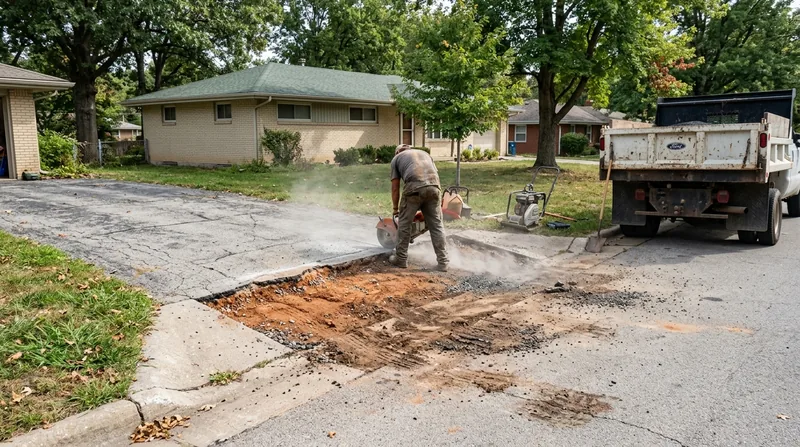




Columbia driveways crack along clay soft spots where cherty limestone shifts underneath them. The silty clay loam that blankets Boone County swells when wet and shrinks when dry, while the karst limestone below settles unevenly, cracking slabs that looked sound on the surface. Thirty-six inches of frost depth and the many freeze-thaw crossings of a Missouri winter keep working on whatever the clay has already moved. Driveway repair in Columbia means cutting out the failed asphalt, rebuilding the base where clay has softened, and patching with hot mix rated for this climate. Whether you own a narrow driveway on a historic lot near downtown or a two-car drive in one of the newer subdivisions on the south side, freeze-thaw failure and clay movement are the real enemies. We rebuild the base, not just patch the surface, because that is what holds in a driveway built over this ground.
Why Driveway Repair Matters in Columbia: The Clay and Frost Problem
Columbia sits on a foundation that works against asphalt. The clay loam holds water and swells; the limestone beneath it caves and settles; and the winter freeze-thaw cycle exploits every weak point. Cracks that start as hairline fractures in spring become potholes by summer and full-depth failures by the next winter. A driveway that was paved over a poor base or soft clay will fail faster, and a patch thrown over a cracked base will fail again. The longer you wait, the more the base degrades, and the more expensive the eventual repair becomes. Getting ahead of that cycle with proper patching and base repair saves money and keeps your driveway safe.
- We identify whether a crack is surface-only or runs through the base by cutting a test hole and checking the layers.
- We remove failed asphalt and soft clay, then rebuild the base with compacted aggregate rated for this soil type and frost depth.
- We patch with hot mix asphalt that meets Missouri standards for freeze-thaw resistance and traffic load.
- We address drainage and slope so water does not pool under the repair and soften the base again.
These steps are the difference between a repair that lasts and money thrown at a symptom.
Key info: In Columbia's historic neighborhoods near downtown and the University of Missouri, driveways on steep aprons toward the bluffs often fail first because water runs off the slope and undercuts the base. Student rental properties and apartment complexes see faster failure because turnover traffic is heavier. The established mid-century subdivisions further out show more uniform failure patterns tied to the original base prep. Newer south-side and east-side subdivisions on rolling terrain cut by Hinkson Creek and its tributaries see localized failures where karst sinkholes or springs work beneath the surface.
For guidance on what permits or approvals your repair may need, check with the City of Columbia Planning and Development Department or your village clerk if you are outside city limits. Driveway apron work, curb cuts, and any changes to impervious surface may require a permit depending on where you live in the service area.
How We Repair Driveways in Columbia: The Process That Holds
A proper driveway repair in Columbia starts with understanding what failed and why. We do not just patch the asphalt; we fix the base. If the base is gone, a patch will fail again within a season. If the base is sound but the asphalt is cracked, we cut out the crack, clean it, and fill it with hot mix. If the base has softened because of water or clay movement, we excavate, replace the base, and then patch. Each job is different, and that is why we look at the driveway in person before we quote.
- We measure the failed area and cut a test hole to see how deep the problem goes.
- We remove the failed asphalt with a saw and a shovel, or with a small excavator if the base is soft.
- We excavate and replace soft clay or degraded base material with compacted aggregate base rated for Missouri frost depth.
- We proof-roll the base to confirm it is stable, then tack the edges of the existing asphalt.
- We place and compact hot mix asphalt to match the existing surface elevation and slope.
- We finish the edges and grade for drainage so water runs off, not under, the repair.
The result is a repair that does not fail again because the base is rebuilt, not just covered.
Example: A home in the Glenwood subdivision on the south side of Columbia had a driveway that cracked every spring for three years. The homeowner patched it each time, but the cracks came back. We cut a test hole and found the base was saturated clay with no drainage. We excavated 18 inches, replaced the clay with 4 inches of compacted limestone base, and patched with 2 inches of hot mix. That repair has held for four years because the base was fixed, not just the surface.
If your driveway is more than 30 to 40 percent failed across its surface, patching throws money away and asphalt resurfacing or a full overlay is the honest call. We tell you that upfront because it saves you money in the long run.
Driveway Repair Methods and When to Use Each
| Repair Type | Description | Best For |
|---|---|---|
| Pothole and Crack Patching | Remove failed asphalt, clean the edges, tack with emulsion, and fill with hot mix compacted to match the surrounding surface. | Single or isolated failures, sound base underneath, less than 10 percent of surface area affected. |
| Full-Depth Patching | Excavate to the base, replace soft clay or degraded base with compacted aggregate, and patch with hot mix in two lifts (binder and surface). | Failures where the base is saturated, clay has swollen, or the original base is missing or inadequate for the soil type. |
| Spall and Edge Repair | Remove spalled or broken asphalt at the edge or corner, rebuild the edge to match the existing slope, and patch with hot mix. | Edge damage from traffic, freeze-thaw spalling, or water undercut; base is intact but the asphalt edge is gone. |
| Alligator Crack Removal and Overlay | If alligator cracking covers 30 to 40 percent or more of the surface, mill the top layer or remove the entire slab and overlay with new asphalt over a rebuilt or confirmed base. | Extensive cracking across the surface; patching would be inefficient; the base is still sound but the asphalt is failing. |
Driveway Repair Cost in Columbia: What to Expect
Driveway repair costs in Columbia depend on how deep the failure goes, how much base needs to be replaced, and how large the failed area is. A simple pothole patch starts at around $450 to $600, but a full-depth repair on a 200-square-foot area with soft base can run $1,200 to $2,000 or more. The difference is not the asphalt; it is the base work. Soft clay, saturated soil, or missing base material means more excavation, more aggregate, more compaction, and a longer job. That is also why the repair holds, because the base is rebuilt.
Factors that move the cost up:
- Size of the failed area: a 50-square-foot pothole costs less than a 200-square-foot slab failure.
- Depth of base failure: if soft clay runs 18 inches deep, excavation and replacement cost more than a 4-inch fix.
- Access and equipment: a narrow driveway in a historic neighborhood may need a small excavator and hand work; a wide drive on the south side may allow a larger machine.
- Drainage and slope: if water is pooling or running under the driveway, we rebuild the slope and may add a swale or apron to shed water away.
- Existing condition: a driveway with multiple failed areas across its surface is a candidate for resurfacing, not piecemeal patching.
Get two or three estimates from local contractors and ask each one to specify the depth of excavation, the tonnage of base material, the type of asphalt, and the finished thickness. That is how you compare apples to apples. A price that sounds too good usually means the base work is being skipped, and that repair will fail again.
For a full breakdown of pricing across all repair and paving services, see our pricing page.
Driveway Repair Near Me: What Columbia Homeowners Should Know When Hiring
Choosing a contractor for driveway repair in Columbia comes down to three things: local presence, honest estimates, and a written contract. The single strongest warning sign is a door-to-door offer with no written estimate, a demand for a large cash deposit, or a price that is too good to be true. Legitimate contractors give you a written estimate with tonnage, thickness, and a start date. They have local plates, a local address, and references you can call. They do not pressure you and they do not ask for payment until the work is done.
What to check before you hire:
- Ask whether the contractor is fully insured and ask to see a certificate of insurance that covers the work.
- Check whether your city or village requires a permit for driveway repair and whether the contractor helps you navigate the permit process.
- Get a written estimate that specifies the depth of excavation, the tonnage of base material, the type of asphalt, the finished thickness, and the timeline.
- Call references from recent jobs in Columbia and ask whether the repair has held and whether the contractor was professional and on time.
- If you live in an HOA community, check the architectural standards before you book; some HOAs restrict driveway widening or require approval for major repairs.
- Ask the contractor whether they pull permits or whether you do; permitting rules vary by city and village in the service area.
Columbia Asphalt Paving has been in business since 2015 and serves Columbia and the surrounding area with local trucks and crews. We give you a written estimate with tonnage and thickness specs, and we are happy to answer questions about the work before you decide. Call us at (573) 488-6542 for a free, no-obligation estimate, or contact us online and we will respond within 24 hours.
Driveway Repair in Columbia: Pricing Guide
| Service | Price | Details |
|---|---|---|
| Pothole and Crack Patching | Starting at $450 | Single pothole or isolated crack repair with sound base underneath, up to 50 square feet affected area |
| Full-Depth Repair | Starting at $1,200 | Excavation, base replacement, and patching when soft clay or degraded base is found, typically 100 to 200 square feet |
| Spall and Edge Repair | Starting at $600 | Repair of broken or spalled asphalt edges, freeze-thaw damage, or corner failure with intact underlying base |
| Multiple or Extensive Failures | On estimate | When 30 percent or more of driveway surface shows alligator cracking or potholes, resurfacing or overlay is more cost-effective than patching |
| Travel | Included | No separate mileage or call-out fee within Columbia and surrounding service areas |
| Free Estimate | Free | Written estimate with tonnage and thickness specs, response within 24 hours at (573) 488-6542 |
Indicative pricing, the exact cost depends on square footage, finish, and site access. Free personalized estimate within 24h at (573) 488-6542.


