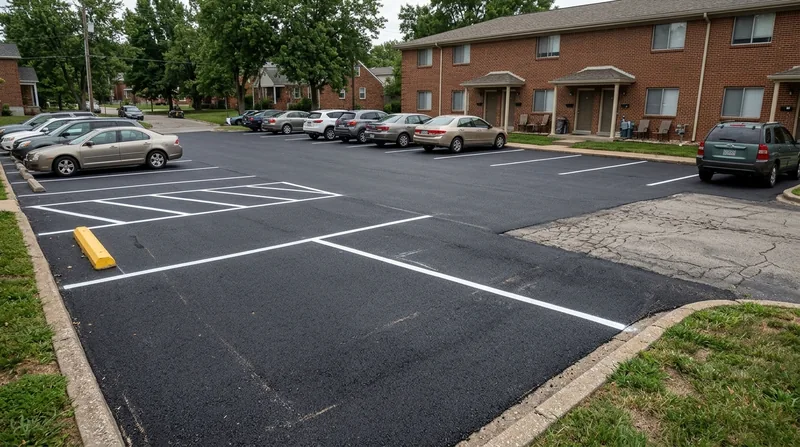




Columbia's student rentals, apartment complexes, and commercial properties face heavy seasonal traffic that breaks down parking lots fast. The freeze-thaw cycles of a Missouri winter, combined with spring runoff from Hinkson Creek's watershed, put constant pressure on asphalt surfaces that weren't built for repeated loading or drainage. Parking lot paving and construction in Columbia demands a base thick enough to handle turnover traffic, proper pitch to shed water, and materials that hold up through thirty-six inches of frost depth. We build parking lots that stay intact through semester changeover and spring storms, with written estimates that specify tonnage and compaction so you know what you're paying for.
Why Parking Lot Paving and Construction Matters in Columbia's High-Traffic Market
University of Missouri student housing, retail centers, and office parks in Columbia turn over tenants and customer traffic seasonally. A parking lot built for light use or cut corners on base preparation fails faster under that load, and a surface that doesn't slope correctly holds water, which accelerates cracking and potholing. The silty clay loam beneath Columbia's parking lots swells when wet and settles unevenly, so proper grading and a compacted aggregate base are not optional. When you add the thaw-crack cycle of a Missouri winter, an undersized or poorly pitched lot becomes a liability within three to five years.
- We size the base and binder course for the traffic load your lot will actually carry, not a generic rule of thumb.
- We pitch the surface to drain standing water within hours of heavy rain, preventing subsurface saturation and frost heave.
- We compact every layer with proof rolling to verify bearing capacity before we lay the surface course.
- We use hot mix asphalt in binder and surface grades appropriate to Columbia's climate and your traffic pattern.
- We pull or help you navigate local permitting, stormwater rules, and any HOA or municipal curb-cut requirements.
A properly built parking lot in Columbia holds its surface for ten to fifteen years, even under heavy semester turnover, because the foundation is right from day one.
Key info: Columbia's municipal stormwater rules and impervious-surface limits vary by zone. Check with the City of Columbia Public Works or your local building department before breaking ground. Some properties near the Hinkson Creek watershed face additional drainage requirements. We help you understand what your site needs.
For more detail on how parking lot issues develop and what repair or replacement looks like, see our parking lot repair and resurfacing page.
How We Build a Parking Lot in Columbia: Base, Pitch, and Compaction
Parking lot construction starts underground. We clear and grade the subgrade, set the proper pitch for drainage, lay and compact a stone base to the depth and density your site needs, then build the asphalt in two courses so the surface stays stable under repeated loading. Every step is inspected and documented so you have proof that the lot was built to spec, not eyeballed.
- We survey and stake the lot to establish proper drainage pitch, typically 1 to 2 percent slope toward storm drains or swales.
- We excavate or grade the subgrade, remove unsuitable material, and proof-roll to confirm bearing capacity.
- We lay a compacted aggregate base course, usually 4 to 6 inches on a new build, and verify density with proof rolling or nuclear density testing.
- We apply a tack coat between the base and binder course to ensure adhesion.
- We lay the binder course, typically 1.5 to 2 inches, compacted and cooled.
- We apply a second tack coat and lay the final surface course, usually 1.5 to 2 inches, finished smooth and ready for striping and signage.
The entire process takes three to five days for a typical 50-space lot, depending on weather and the size of the subgrade work. You get a written estimate with tonnage specifications and compaction targets before we start.
Example: A 25,000-square-foot apartment complex lot in north Columbia required full depth replacement because the original base had settled unevenly under ten years of turnover traffic. We removed the failed surface, regraded the subgrade, installed a 5-inch compacted base, and laid new binder and surface courses. The lot now handles seasonal loading and spring runoff without ponding. Total time: four days. The property manager verified every compaction reading before we paved.
For details on what happens when a lot does fail and how repair versus replacement is decided, see asphalt resurfacing and overlay options.
Parking Lot Construction Methods and Materials for Columbia
| Approach | Description | Best for |
|---|---|---|
| Full-Depth Replacement | Remove all failed asphalt and base, regradesubgrade, install new aggregate base and two-course asphalt surface. | Lots with settled or broken base, extensive alligator cracking, or poor drainage history. |
| Mill and Overlay | Remove the top 1.5 to 2.5 inches of failed surface, re-grade for pitch, lay new binder and surface courses over the existing base. | Lots with sound base but failed surface, rutting, or minor cracking. Saves time and cost. |
| Recycled Asphalt Millings Base | Use reclaimed asphalt as the aggregate base layer, compacted and stabilized, then top with new hot mix surface course. | Budget-conscious projects, gravel lots upgrading to asphalt, or secondary parking areas with lower traffic. |
| Pothole and Spot Patching | Cut out failed areas to solid base, apply tack, and fill with new hot mix compacted flush with surrounding surface. | Isolated failures under 10 to 15 percent of lot surface. Quick, targeted repair. |
Each method has a cost and timeline. We recommend the approach that gives you the longest life for the dollar, and we explain why one method will outlast another on your specific lot.
Parking Lot Paving and Construction Cost in Columbia: What to Expect
The cost of parking lot paving in Columbia depends on lot size, subgrade condition, drainage requirements, and whether you need full replacement or an overlay. We provide a free commercial estimate with written tonnage and compaction specifications so you know exactly what you're paying for. Most parking lots in the Columbia area range from $2.50 to $4.50 per square foot for a complete new build, depending on base depth, asphalt grade, and site complexity. A 25,000-square-foot lot typically costs $62,500 to $112,500 for full depth replacement, or $37,500 to $75,000 for a mill and overlay if the base is sound.
Factors that move the price up or down include:
- Subgrade condition and regrading needs, especially on lots with karst sinkholes or poor drainage history.
- Base depth and compaction requirements, which vary by traffic load and local soil bearing capacity.
- Proximity to Hinkson Creek or other drainage-sensitive areas that may require stormwater permits or swales.
- Removal and disposal of failed material, which adds cost if the lot is heavily cracked or the base is contaminated.
- Striping, signage, and curbing, which are separate line items and vary by lot layout.
Get a free estimate from us and at least one other contractor so you can compare scope, tonnage, and price. The estimate that shows the most detail about base depth, compaction, and asphalt grade is the one most likely to deliver a lot that lasts.
For a full pricing overview and examples of cost factors, see our pricing page.
Parking Lot Paving and Construction Near Me: What Columbia Property Managers Should Know
Hiring a parking lot contractor in Columbia starts with verifying they are fully insured and have a local address and local plates. The single strongest warning sign in paving is an out-of-state crew showing up with an offer to use leftover asphalt from a nearby job, no written contract, and a price that sounds too good. Honest contractors give you a written estimate with tonnage, compaction specs, and a timeline before they touch your lot.
When you call a contractor, ask for:
- A site visit and written estimate that specifies base depth, binder course thickness, surface course thickness, and compaction method.
- References from other commercial properties in Columbia or nearby towns, and permission to call them.
- Proof of current liability insurance and contact information for their insurance carrier.
- Clarification of what permits they will help you obtain, versus what you need to verify with the City of Columbia or your HOA.
- A timeline for completion and what weather conditions might delay the work.
If the contractor is hesitant to put anything in writing, or asks for a large cash deposit before the estimate is signed, move on. Legitimate parking lot work in Columbia requires site inspection, measurement, and a clear written scope before any money changes hands. Contact us at (573) 488-6542 to schedule a free estimate with no obligation.
Parking Lot Paving & Construction in Columbia: Pricing Guide
| Service | Price | Details |
|---|---|---|
| Free commercial estimate | Free | Site visit, lot measurement, subgrade assessment, written tonnage and compaction specs, no obligation to book |
| Mill and overlay (per sq ft) | Starting at $1.75 | Milling existing surface, new binder and surface courses, compaction, assumes sound base and moderate drainage slope |
| Full-depth replacement (per sq ft) | Starting at $2.50 | Removal and disposal, subgrade regrading, compacted aggregate base, binder and surface courses, proof rolling, permits |
| Recycled asphalt base with new surface (per sq ft) | Starting at $1.50 | Reuse of milled asphalt as base layer, compaction, new hot mix surface course, best for secondary lots or tight budgets |
| Pothole and spot patching (per patch) | Starting at $150 | Cut and removal of failed area, base inspection, new hot mix fill, compaction, price varies by patch size and base condition |
| Travel and mobilization | Included | No separate charge in Columbia and surrounding service areas, included in the job estimate and final invoice |
Indicative pricing, the exact cost depends on square footage, finish, and site access. Free personalized estimate within 24h at (573) 488-6542.


