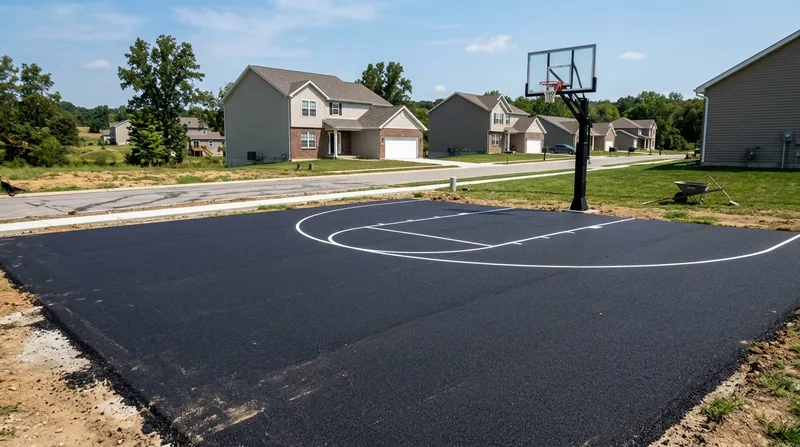




Columbia schools and subdivisions on the south side of Boone County are adding sports court and path paving at a steady pace, and the local terrain makes every installation a structural problem worth solving right. The silty clay loam under these properties holds water and swells through freeze-thaw cycles, while the cherty limestone bedrock below settles unevenly, cracking shallow bases and pushing up frost heaves that crack asphalt surfaces. A properly built sports court sits on a compacted aggregate base, hot mix binder and surface courses laid to strict thickness, and drainage pitched to clear the heavy spring rains that run off Boone County toward Hinkson Creek. We build that base, pour the asphalt to spec, and finish a smooth playing surface that holds through the seasons. Grading and base preparation are the foundation of every court we build.
Why Sports Court and Path Paving Matters in Columbia's Growing School and Recreation Districts
Columbia Public Schools and the subdivisions expanding on the south side rely on asphalt courts for basketball, tennis, and multi-sport use. A court built on unstable ground or too thin will crack, heave, and fail within a season or two, leaving the school or HOA with repair bills that dwarf the cost of doing the job right the first time. The freeze-thaw cycle in Columbia runs thirty-six inches deep, and the clay-rich soil here swells and shrinks with every winter, putting constant pressure on any surface that sits on a weak or improperly compacted base.
- We compact aggregate base material to the density required for asphalt to perform over clay and karst terrain.
- We pour hot mix asphalt in a binder course and wearing surface, meeting thickness specs for the intended use.
- We pitch and finish the surface to shed water and prevent ponding that accelerates failure.
- We verify drainage patterns before and after paving to protect the base from saturation.
A court built this way will perform through the seasons and justify the investment.
Key info: Columbia Public Schools and subdivisions in Boone County must verify local permitting with the City of Columbia Public Works Department and confirm HOA architectural standards before paving begins. Stormwater and impervious surface limits vary by jurisdiction, and compliance is the property owner's responsibility. See Columbia's municipal website for permit requirements in your zone.
How We Build a Sports Court or Path in Columbia: Start to Finish
Sports court paving begins with the ground. We inspect the existing grade, identify drainage patterns, and plan a base that will support asphalt without settling or heaving under the freeze-thaw load. On clay like Columbia's, that means proof rolling the base, adding aggregate to spec thickness, and compacting it in lifts until it meets density. Then we pour hot mix in layers, finish the surface smooth and level, and pitch it to move water off the court and away from the base.
- We measure the site and confirm grades, drainage, and any utility locates required by Missouri 811 law.
- We remove existing surface if present, grade the subgrade, and bring in compacted aggregate base to design thickness.
- We proof roll the base to verify density and identify soft spots before laying asphalt.
- We pour hot mix binder course, compact, and finish the wearing surface to final grade and pitch.
- We verify surface drainage and mark the court ready for use after curing per manufacturer guidance.
The result is a court that will not heave or crack under Columbia's winters and will shed water rather than trap it.
Local example: A school district in south Columbia wanted to add a basketball court on a low-lying lot that held water after spring rains. We graded the site to drain toward an existing culvert, built a four-inch compacted base, and poured three inches of hot mix pitched to shed water. The court opened on schedule and has held through four winters without cracking or settling.
If you are planning a court or path on property with drainage concerns or clay-heavy soil, contact us for a free estimate and we will walk the site with you.
Sports Court and Path Paving Methods: Choosing the Right Approach
The method we use depends on the intended use, the soil below, and the local terrain. A walking path on stable ground requires less base than a basketball court where players will jump and cut. We match the design to the load, the site, and the long-term durability you need.
| Approach | Description | Best for |
|---|---|---|
| Full-depth court paving | Subgrade grading, compacted aggregate base, hot mix binder and surface courses, drainage design and pitch. | New courts on clay soil, sites with poor drainage, high-use athletic facilities, basketball and tennis courts. |
| Overlay on existing base | Milling the top layer if needed, proof rolling the existing base, laying new hot mix binder and surface. | Courts with sound bases but worn surfaces, paths over stable ground, budget-conscious resurfacing. |
| Walking path paving | Grading to slope, two to three inches of compacted base, two inches of hot mix, pitched to drain. | Pedestrian paths in parks and subdivisions, connecting walkways, low-impact recreational trails. |
| Multi-use court with special finish | Full-depth build with textured or smooth finish, line marking, and drainage designed for multiple sports. | School courts, community recreation facilities, HOA amenity spaces used for basketball and tennis. |
Each method is priced on site based on soil conditions, drainage, and the specifications the court or path requires. We will walk the ground with you and explain which approach makes sense for your property.
Sports Court and Path Paving Cost in Columbia: What to Expect
A new sports court in Columbia starts at around $8,500 for a small court or path on stable ground with a straightforward base and surface build. The final cost depends on several real factors: the size of the court or path, whether you are building on existing asphalt or bare ground, the depth of the base required for the soil and climate, and the complexity of drainage. A full-size basketball court with a properly engineered base on clay soil will run significantly more. A simple walking path on already-stable ground will cost less.
We recommend getting two or three estimates from local contractors who will visit the site and explain what the base and surface design costs. A written estimate should include the thickness of the base and surface, the tonnage of asphalt, and the drainage plan. If a contractor gives you a per-square-foot price without seeing the site, or a price that seems too good to be true, ask why the base design is not detailed in the estimate.
See our full pricing overview for a breakdown of typical sports court and path projects, and call us at (573) 488-6542 for a free estimate on your property.
Sports Court and Path Paving Near Me: What to Look for When Hiring a Paving Contractor in Columbia
A paving contractor in Columbia should be verifiably local, carry full insurance, and provide a written estimate with tonnage and thickness specified. The single strongest trust signal in this trade is a local address and local plates, because the historic fraud in asphalt paving is the itinerant crew that shows up with a truck, offers you a price for leftover material from a nearby job, and disappears when the asphalt fails. Honest guidance is the differentiator. A contractor worth hiring will propose repair or resurfacing before replacement, explain why the base matters, and walk the site with you before giving a price.
- Verify that the contractor is fully insured and ask for a certificate of insurance covering general liability and property damage.
- Get written estimates from at least two contractors, and compare the base thickness, surface thickness, and tonnage specified.
- Check references from other schools, HOAs, or property owners in Columbia or nearby counties who have had courts or paths built.
- Confirm with the City of Columbia or your HOA whether permits are required and what architectural or stormwater standards apply.
- Ask the contractor to explain the drainage plan and how the surface will shed water in heavy spring rains.
A contractor who takes time to understand your site and explains the work in writing is the one most likely to deliver a court that lasts.
Contact us for a free estimate and we will walk your property with you, explain the base and surface design, and give you a price in writing.
Sports Court & Path Paving in Columbia: Pricing Guide
| Service | Price | Details |
|---|---|---|
| Small walking path or court | Starting at $8,500 | Grading, compacted base, two to three inches of hot mix, pitched for drainage on stable ground |
| Full-size basketball or tennis court | Starting at $18,000 | Subgrade grading, four-inch compacted base, hot mix binder and surface, pitch and drainage design |
| Multi-court facility or large path system | On estimate | Site-specific grading, base design for clay soil and freeze-thaw cycle, drainage infrastructure, multiple surfaces |
| Overlay or resurfacing existing court | Starting at $6,500 | Assumes sound existing base, proof rolling, new hot mix binder and wearing surface, re-pitch for drainage |
| Travel and site visit | Included | No separate charge for estimates or travel within Columbia and surrounding Boone County service areas |
| Free written estimate | Free | Response within 24 hours at (573) 488-6542 with site walk, thickness specs, and tonnage detail |
Indicative pricing, the exact cost depends on square footage, finish, and site access. Free personalized estimate within 24h at (573) 488-6542.


